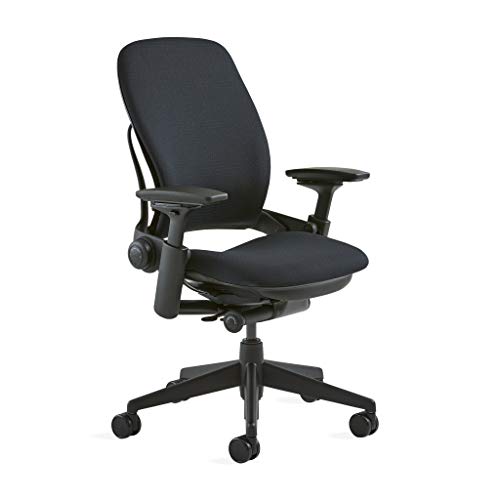
If one chair in our lineup is built for people who like to adjust things, it is the Steelcase Leap. Steelcase’s own page calls it a highly adjustable chair, with controls for the seat, the back, the arms and the recline. We rank it first because it lets you set up more contact points than any other model we compared. We do not test chairs, so everything below comes from Steelcase’s published pages and spec guide, and we say so when a figure is missing.
This product is not a medical device and does not replace advice from a healthcare professional. Read the manufacturer's instructions before first use.
Which Leap Is This?
The Amazon listing is the standard Steelcase Leap work chair in a fabric finish with a black frame, sold with casters for carpet. Steelcase sells the Leap in several forms, and the differences matter for fit:
- Leap (standard): the chair this page covers, rated by Steelcase for up to 400 lbs.
- Leap Plus: a larger frame rated by Steelcase for up to 500 lbs. It has a wider seat and back and is not the listing on this page.
- Leap stool: a taller version rated at 300 lbs.
Because the names are so close, check that the listing says Leap and not Leap Plus before you rely on any number below. Steelcase sells the chair in many upholstery and frame combinations, and its’s page lists fabric, leather and vinyl, plus a 3D Knit back option. Your color and material may differ from the one pictured.
Adjustments You Get
Steelcase’s Leap page lists the following adjustments, and its October 2020 seating specification guide gives the ranges:
- Seat height: a 5-inch pneumatic range, 15.5 to 20.5 inches from the floor according to Steelcase’s guide, with a 7-inch range available as an option.
- Seat depth: a 3-inch range, giving a functional seat depth of 15.75 to 18.75 inches. Steelcase says seat depth adjustment is standard on all models.
- Lumbar: a height-adjustable lumbar support, with a 5-inch adjustment range, plus a lower back firmness dial that changes how firm the lower part of the back feels. Steelcase’s guide says the lumbar can be omitted on some configurations, so confirm it is present.
- Arms: standard 4D arms that adjust in height, width, depth and pivot. Steelcase lists an arm height range from the seat of 7 to 11 inches, a width between the arms of 15 to 20 inches, and a pivot of 30 degrees in or out.
- Recline: full recline with four recline angle stops and an upright back lock. The seat-to-back angle runs from 96 to 120 degrees. Steelcase also lists an upper back force control and a variable back stop.
- Seat edge: a flexible seat edge that Steelcase says bends up to 1.5 inches at the front.
That is a long list, and it explains the chair’s reputation. On a cheaper task chair you typically get a height lever, a tilt lock and maybe one tension knob. Here every part of the chair that touches you can be positioned separately.
The Back and the Seat
Steelcase says the Leap was its first chair built with LiveBack technology. The back is made of parallel slats that flex so the shape of the backrest changes as you move. We make no claim about how it feels or what it does for your body. The spec guide tells us only that the back is a flexing shell, not a rigid plate, with 25 inches of back height from the seat and an 18-inch back width.
The seat is 19.25 inches wide in Steelcase’s guide, with the flexible edge mentioned above. Steelcase’s page also notes that the Leap glides the seat forward and back as you recline, a feature it calls the Natural Glide System, so that the seat and back move together instead of the back moving alone.
Weight Rating and Build
Steelcase’s page says the Leap is durable enough to handle weight up to 400 lbs. That is the highest rating among the standard-size chairs we compared, which is a reason heavier buyers shortlist it. If you weigh more than 350 lbs or need a very wide seat, look at what Steelcase says about the Leap Plus, which has a different frame.
Steelcase’s pages do not give an assembly time or a chair weight that we could confirm, so plan on a second person to help you lift the box.
Casters and Floors
Steelcase’s specification guide says the standard casters are hard, dual-wheel units that roll smoothly on carpet, and that soft, dark gray roll-control casters are available for hard floors or chair mats. The Amazon listing is labeled for carpet floors. If your home office has wood, tile or vinyl flooring, a clear chair mat is a sensible addition, and so is asking the seller whether a soft-caster version is available. Steelcase also warns not to roll the chair across asphalt during installation, since that can damage the casters.
OSHA’s computer workstation guidance says a chair should have a five-leg base with casters, and that casters should suit the type of floor under the desk. The Leap meets the first part. The second part is up to you.
Warranty
Steelcase’s product page describes a Limited Lifetime warranty that covers 12 years, multi-shift, 24/7 parts and labor. Warranty terms usually depend on where you buy and on how the chair is used, and the page does not give full conditions, so read Steelcase’s warranty text and ask the seller who handles claims.
Fit: Who It Suits
Steelcase’s own materials do not publish a recommended user height range for the Leap, so we do not give one. What we can give you is the hardware: a seat that goes down to 15.5 inches and up to 20.5 inches, a seat depth that moves through 3 inches, and arms with a wide range of travel. OSHA’s guidance says the seat height is right when the entire sole of the foot can rest on the floor, and that the seat pan should let taller users have thigh support while letting shorter users keep their backs against the backrest. A chair with an adjustable seat height and depth gives you the tools for that. Set the seat height first, then the depth, then the arms.
If you are shorter and cannot get your feet flat at 15.5 inches, OSHA says to use a footrest. If you are very tall, ask about the 7-inch cylinder option.
Pros and Cons
Pros
- Adjustable seat height, seat depth, lumbar height, back firmness, arm height, width, depth and pivot
- 400 lb weight rating from Steelcase
- Four recline stops and an upright lock
- Long warranty from a company that sells to offices
- Flexible back and flexible seat edge
Cons
- Premium-tier chair, at the top of our price range
- A lot of controls, so setup takes time
- Assembly time and chair weight are not published, so plan on help
- The product page leaves out seat height and caster details, which come from Steelcase’s spec guide instead
Who Should Buy the Steelcase Leap
- People who sit at one desk most of the day and want to set every adjustment themselves.
- Heavier users who want a 400 lb rating from a major maker.
- Home-office buyers who are happy to spend more on one chair they can keep for years.
Who Should Look Elsewhere
- Anyone who wants mesh. The Leap is upholstered. If you want mesh, the Herman Miller Aeron profile covers a pellicle mesh option.
- Buyers who like a simpler chair. The Steelcase Series 1 profile covers Steelcase’s more affordable line with fewer parts.
- People who need a seat wider than 19.25 inches or a rating above 400 lbs. Look at the Leap Plus instead.
Checking the Amazon Listing
- Model name. It should say Leap, not Leap Plus, and not Leap V2 refurbished.
- Casters. Confirm carpet or hard-floor casters match your floor.
- Seller and warranty. Make sure the seller is Steelcase or an authorized dealer.
- Return window. Assemble it promptly and set every adjustment before deciding.
Because we do not list prices on this site, use the button below to see the current price on Amazon.
Bottom Line
The Steelcase Leap is the chair to choose if you want control. Steelcase lists a 400 lb rating, a 5-inch seat height range, a 3-inch seat depth range, lumbar height and firmness controls, 4D arms and four recline stops, backed by a Limited Lifetime warranty that covers 12 years of parts and labor. It is upholstered, assembly details are not published, and it sits at the premium end of this lineup. If you want a mesh alternative, see the Herman Miller Aeron profile.
See price on Amazon
For a side-by-side look at how it stacks up against the other nine chairs on capacity, seat height and warranty, read our 2026 office chair comparison.
Sources